DUTCH? FLEMISH? MORE DUTCH PAINTINGS

In my feeble attempt to clarify the impossible, a side note is in order here as to why some of these “Golden Age” painters are noted as being “Flemish” as opposed to “Dutch.” There was an area called Flanders just prior to 1800 (whose southern borders were nebulous) that encompassed parts of Belgium, the Netherlands, and France. Most of it became part of Belgium in 1830, but yet Flanders is still referred to as an autonomous area called the Flemish region with their own government including a congress. Ypres, Ghent, and Bruges are included in the area known as Flanders. To this day, some think of Brussels, Belgium as being in Flanders as opposed to Belgium. Also, they refer to part of the area as the Benelux Region (with it’s own flag) that encompasses Belgium, Netherlands and Luxembourg. This area was formed in 1944 to promote free trade between these three countries. I don’t think I would want to be involved in a property rights dispute here. Confusing as all that seems, it must be clear to the millions that live there, although they are in a bit of political upheaval at the moment. If anyone can help describe it more clearly, please jump in and comment. Anyway, here are the last of the Dutch Golden Age paintings that I photographed at the Getty and the de Young:

JanSteenBathshebaAftereTheBath1

Bathsheba after the Bath, About 1665-70, Jan Steen, Dutch, 1626-1679, oil on panel

“Depicted here is the moment from the biblical story when Bathsheba receives a letter of summons from King David. In Steen’s interpretation, Bathsheba is a temptress rather than the innocent victim of the king’s passion. Unconcerned by her partial nudity, she stares brazenly at the viewer while her maidservant cuts her toenails. The shoe in the right foreground is a symbol of wantonness; the fountain probably alludes to fertility.”

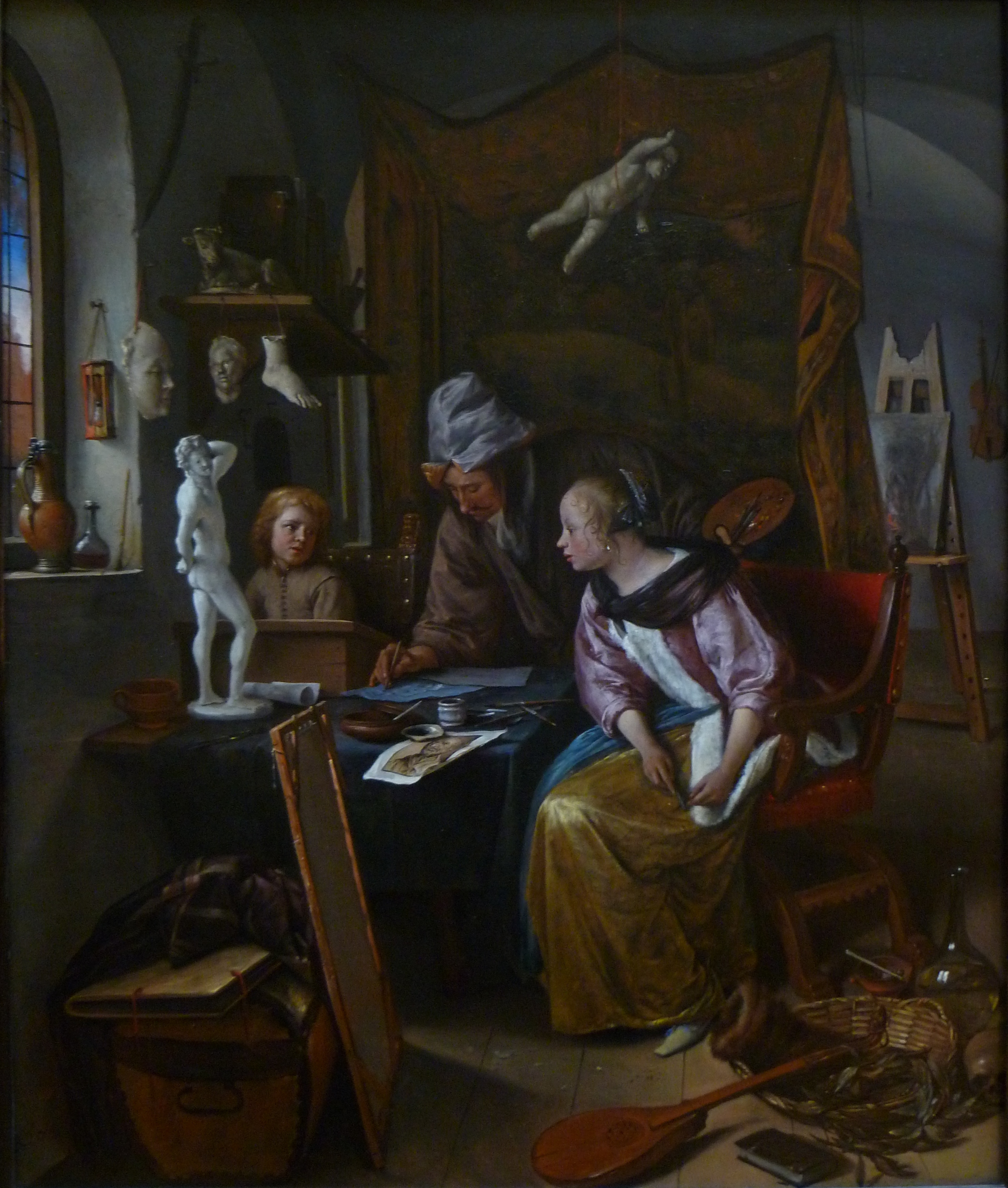
JanSteenTheDrawingLesson2

The Drawing Lesson, About 1665, Jan Steen, oil on panel

“In a studio filled with artistic props, a painter corrects a drawing by one of his two pupils, a young boy and a teenage girl. The cool, clear light from the main window of this idealized interior reveals an array of materials and precisely rendered textures, from plaster to satin, fur, glass, and bone. Steen’s unusually refined technique suggests that this work was meant to celebrate the art of painting.”

JacobVanRuisdaelBridgeWithASluice

Bridge with a Sluice, About 1648-49, Jacob van Ruisdael, Dutch, 1628/29-1682, oil on panel

“Ruisdael’s ability to create complex, monumental images from humble motifs helps explain why he is considered one of the finest landscape painters of the 1600s. Here a rustic sluice, used to regulate water levels and irrigate farmland, is illuminated by a shaft of sunlight. Although the picture contains only one figure, evidence of human activity dominates the scene. Set against a background of productive pastureland, the sluice testifies to man’s continual struggle to control nature.”

JacobVanRuisdaelTwoWaterMillsAndAnOpenSluice

Two Water Mills and an Open Sluice, 1653, Jacob van Ruisdael, oil on canvas

JanVanHuysumVaseOfFlowers

Vase of Flowers, 1722, Jan van Huysum, Dutch, 1682-1749, oil on panel, 31 1/4 x 24

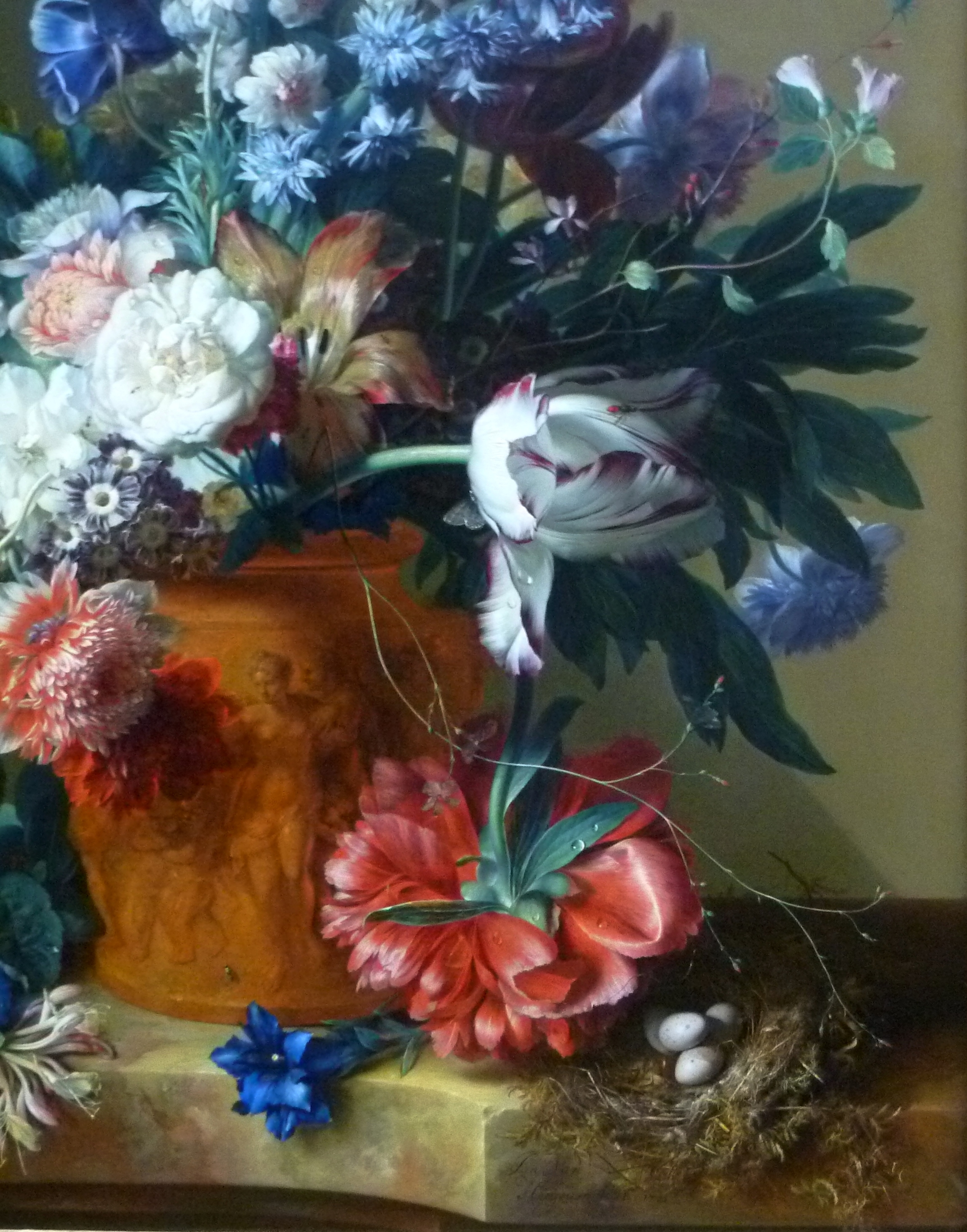
JanVanHuysumVaseOfFlowersCloseup

Vase of Flowers closeup

“In this work, flowers from all times of year–roses, anemones, hyacinths, and tulips, among others–have been painted directly from life. Van Huysum’s painstaking application of multiple layers of think oil glazes captures the brilliant colors and delicate textures of the petals. His vivid greens, however, were fugitive; here the leaves have faded to blue. Because he insisted on only painting each kind of flower while it was in season, it sometimes took the artist years to complete a picture.” http://www.getty.edu/art/gettyguide/artObjectDetails?artobj=817

JanVanHuysumFruitPiece1

Fruit Piece, 1722, Jan van Huysum, oil on panel, 31 1/4 x 24

JanVanHuysumFruitPieceCloseup

Fruit Piece closeup

“This lavish still life of fruit and flowers combines the lustrous realism of Dutch paitnings of the 1600s with the bright colors and sinuous rhythms characteristic of the Rococo style of the 1700s. The effect is lush and extravagantly varied–van Huysum deftly captured the translucence of overripe fruit, the weight of heavy blooms, the crisp surfaes of leaves, and the wiry tension of vines. The artist jealously guardedd his technical secrets, allowing no one to visit his studio.” http://www.getty.edu/art/gettyguide/artObjectDetails?artobj=818

Oh, if only we knew something about van Huysum’s working methods! We could learn so much from him. These paintings were affected by the skylights so that I had a very difficult time photographing them sans reflections.

Note: All text in quotes is taken from the Getty or de Young museum placards posted beside paintings.

FINISHING UP THE DUTCH/FLEMISH PHOTOS

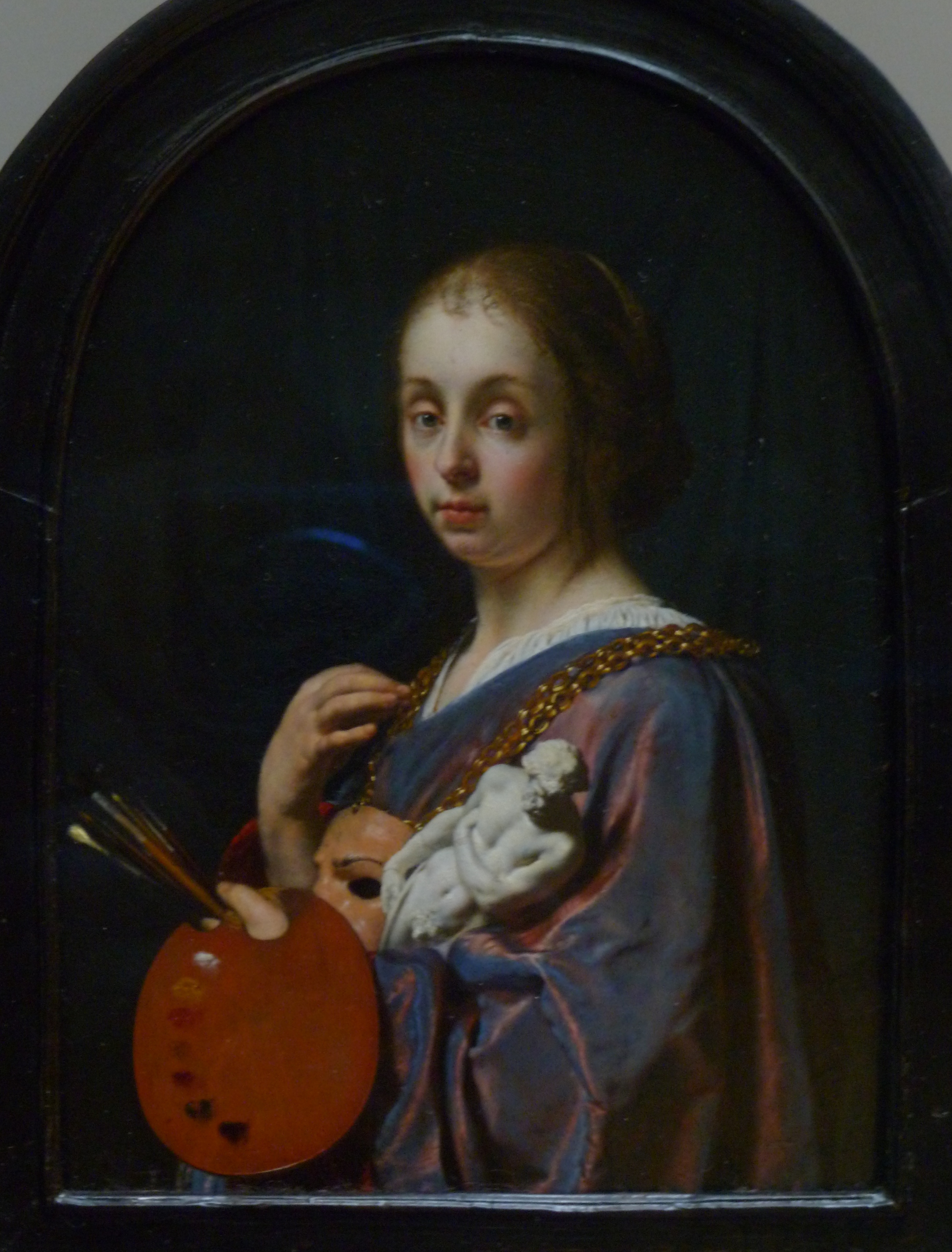
Today, I am posting a lot of photos I took of Dutch/Flemish works that were on exhibit at the de Young and the Getty museums, beginning with Frans van Mieris the Elder (Dutch, 1635-1681). The first is Pictura (Allegory of Painting), 1661, oil on copper. This one was behind glass so please excuse the reflection.

The caption reads, “The allegorical figure shown here represents the art of painting. She holds a palette,, brushes, and a small plaster sculpture. The mask on a chain may refer to art’s deceptive illusions. Instead of being hung on a wall, a painting of this size, like a precious object, would have been kept in a cabinet for close examination. ”

FransVanMierisOilCopperPicturaAllegoryOfPainting

FransVanMierisTheDoctor'sVisit

The Doctor’s Visit, 1667, oil on panel

“Van Mieris was well known for his finely painted works. Here a young woman faints as a doctor examines a vial of her urine. The ostentatious doctor, whose extravagant clothes suggest that he is a quack, was a stock figure in contemporary theater. The erotic painting over the fireplace hints that the woman suffers from lovesickness, while the burning ribbon held by the crying girl was seen at the time as a sign of pregnancy.”

FransVanMierisAYoungWomanFeedingAParrot

A Young Woman Feeding a Parrot, 1663, oil on panel

Painted in the same year as Vermeer‘s “A Woman Holding a Balance,” Van Mieris’ elegant scene was one of the most celebrated and most copied compositions of the time.
The following two Frans Hals paintings are quite large–larger than life.

HalsLucasDeClercque

Lucas de Clercq, Dutch, about 1635, Frans Hals, oil on canvas, 49 13/16 x 36 5/8

HalsFeynaVanSteenkiste

Feyna van Steenkiste, Dutch, about 1635, Frans Hals, oil on canvas, 48 7/16 x 36 5/8

HalsFeynaVanSteenkisteHandsCloseup

Closeup of Feyna’s hands

These two paintings came to the Getty as part of the conservation partnership program. For information on the restoration and removal of old varnish on these two paintings as well as stories about Lucas and Feyna’s lives and additional insights into Hals’ working methods, go to http://www.getty.edu/museum/conservation/partnerships/rijksmuseum_hals/index.html

This painting by Anthony van Dyke was huge. I include the first photo to give you an idea of just how large it was:

AnthonyVanDyckPortraitOfAgostinoPallavicini

AnthonyVanDyckPortraitOfAgostinoPallavicini2

Portrait of Agostino Pallavicini, About 1621, oil on canvas, Anthony van Dyck, Flemish, 1599-1641

“This portrait commemorates the sitter’s service as ambassador of the Republic of Genoa to the newly elected Pope Gregory XV. The artist depicted Agostino Pallavicini, the future head of the state of Genoa, in his sumptuous robes of office, seated before a billowing curtain that bears his family’s coat of arms. The elegant formality of the image exemplifies van Dyck’s highly influential approach to portraiture.”

Note: All text in quotes is taken from the Getty or de Young museum placards posted beside paintings.

RUBENS AND BRUGEHEL COLLABORATE

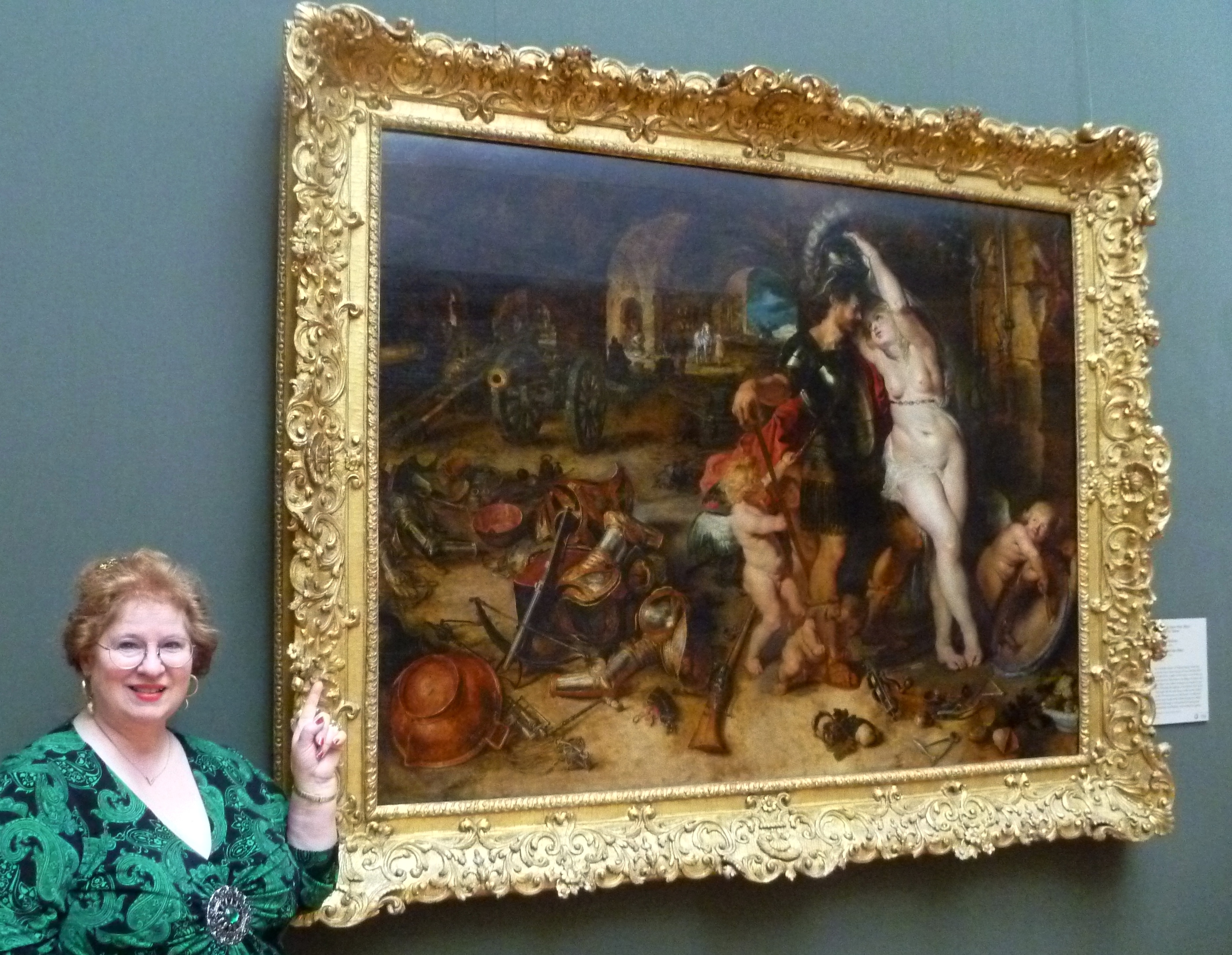
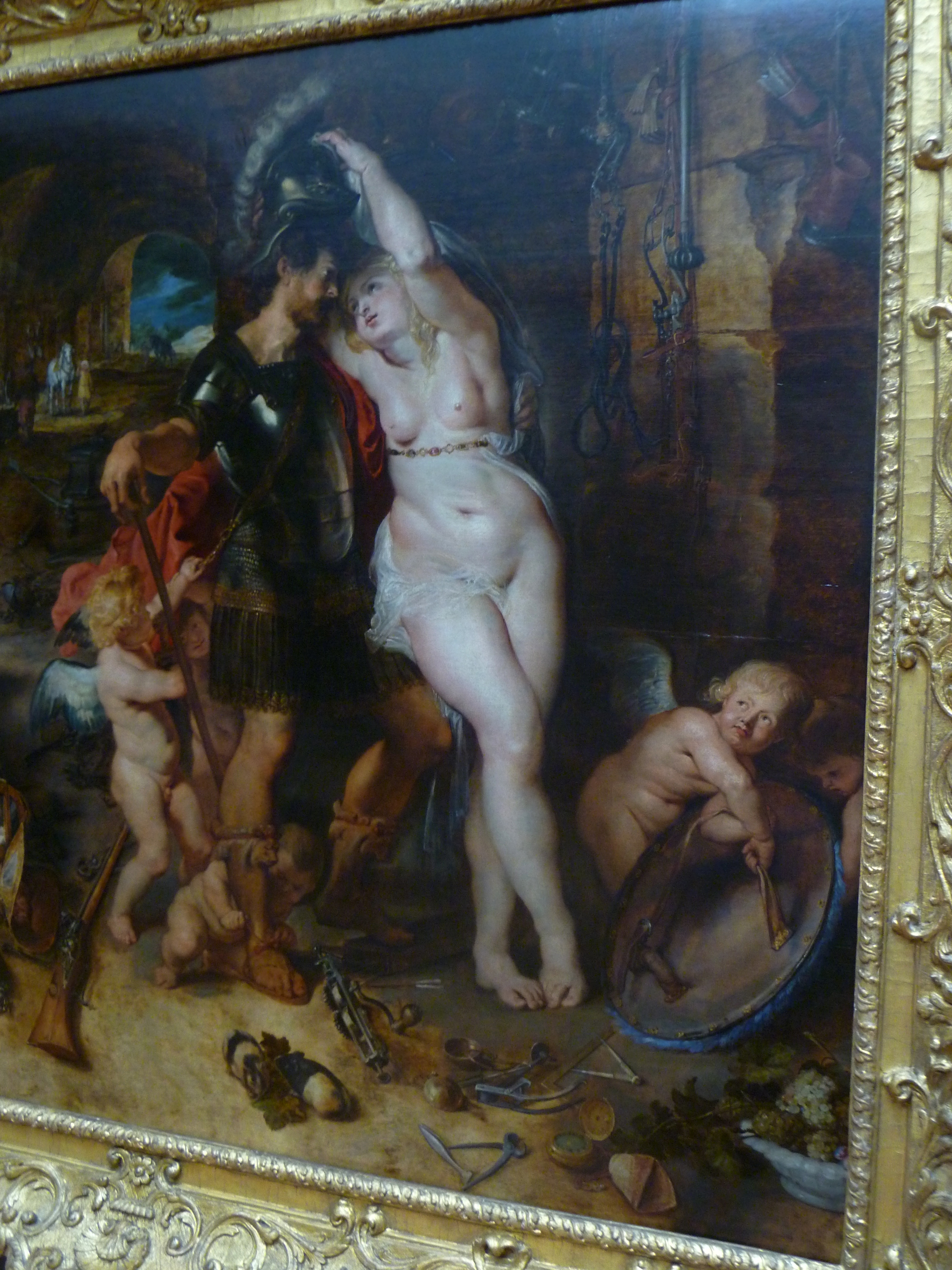
I had an impossible time photographing this painting due to the skylight reflections, a problem I’ve mentioned previously.  I took a general one (had to get my picture beside it :-)), and then I took a few closeups. Here is the painting and the information posted alongside:

RubensBrughelMarsha

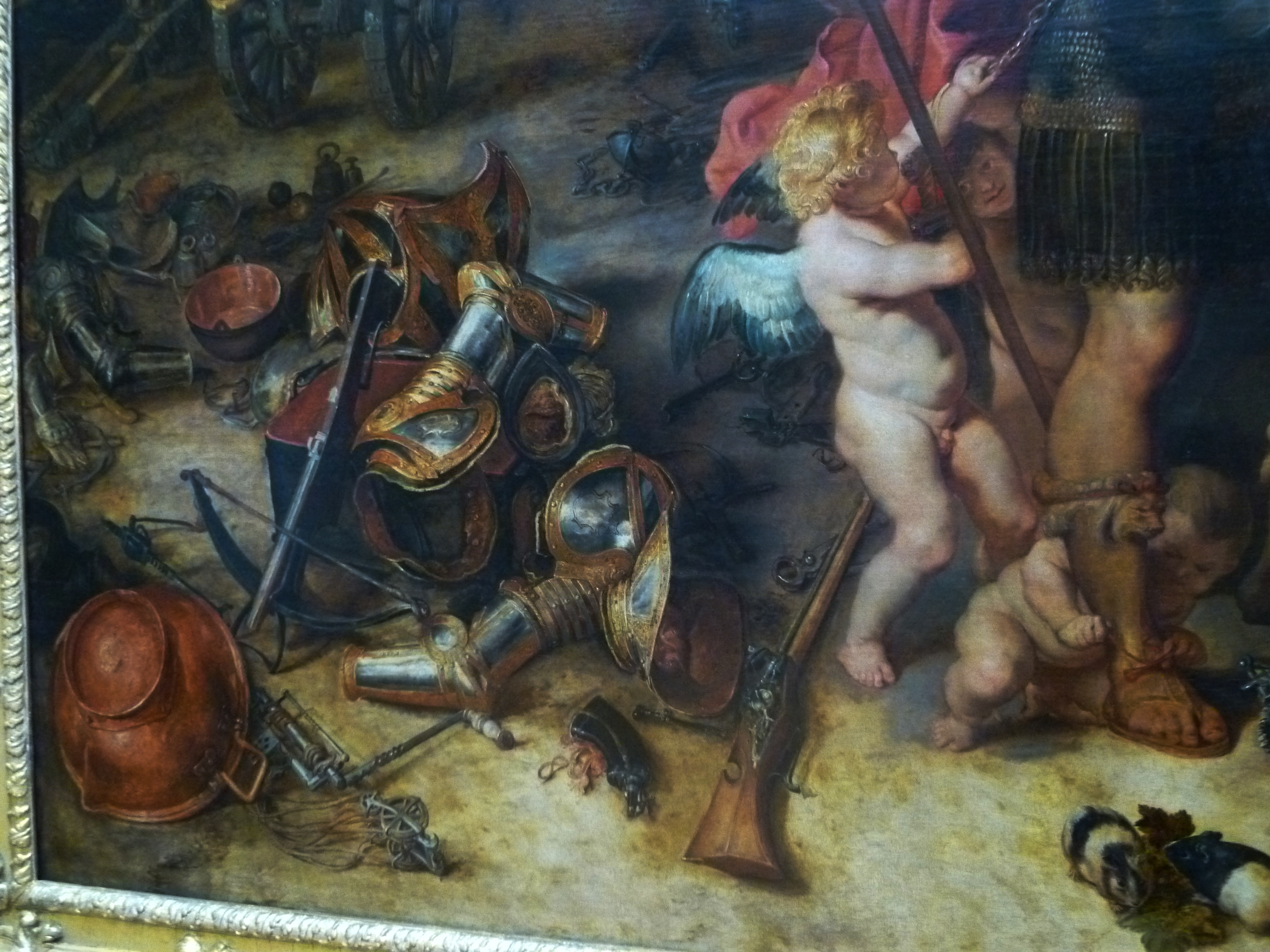
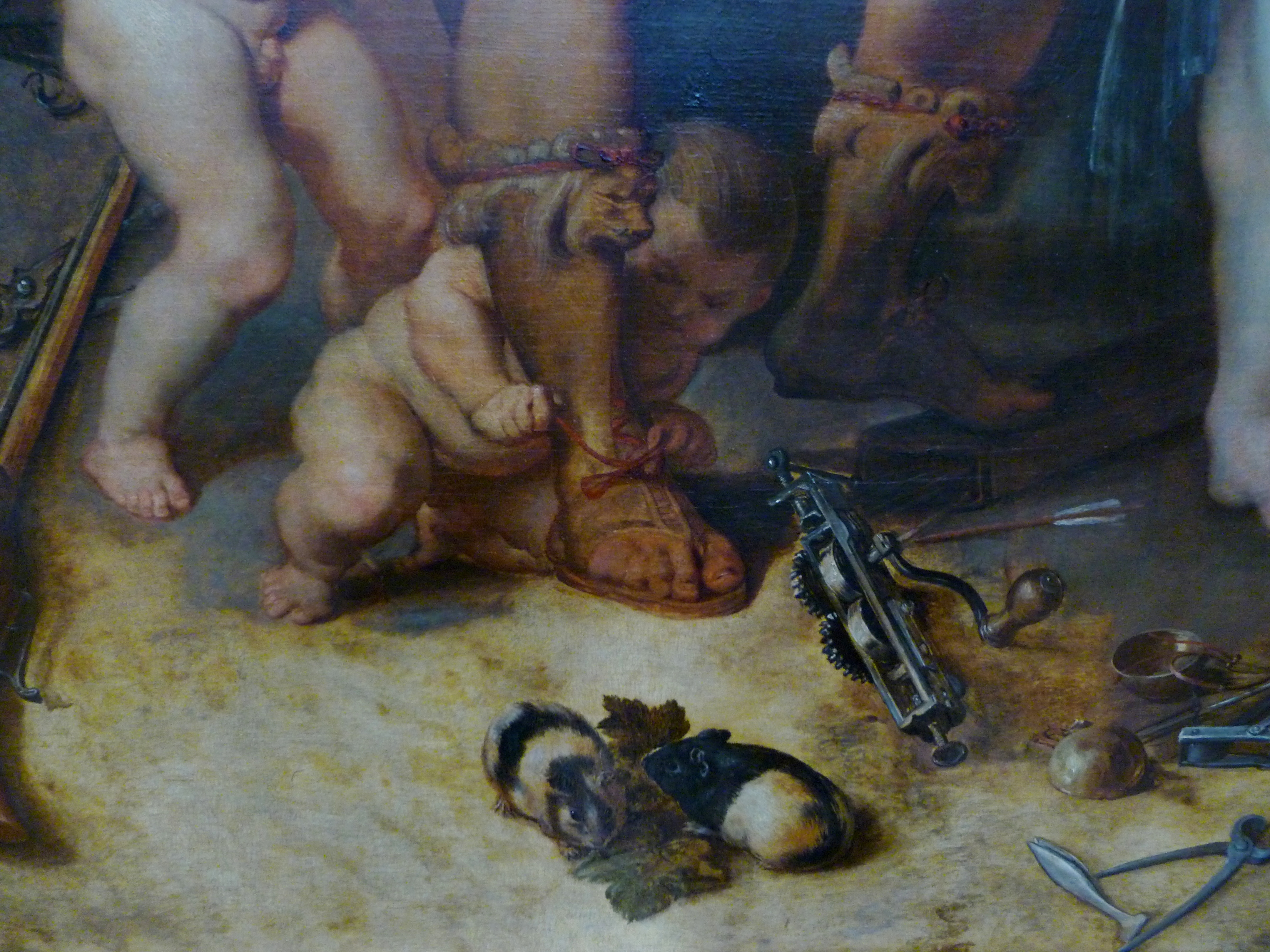
The Return from War: Mars Disarmed by Venus, 1610-12, Peter Paul Rubens, Flemish, 1577-1640; Jan Brueghel the Elder, Flemish, 1568-1625, Oil on panel

“In a secluded corner of Vulcan’s forge, Venus disarms her lover Mars, the god of war, with the playful help of her cupids. Love’s victory over Strife was understood in this period as an allegory of peace, and the subject may reflect contemporary hope for concord following the signing of the Twelve-Year Truce that ended the decades-long conflict in the Netherlands. The harmonious combination of reflective armor and creamy flesh resulted from the collaboration of Brueghel, who painted the setting and armaments, and Rubens, who painted the figures.”

Here are some closeups:

RubensBrueghelTheReturnFromWarCloseup

RubensBrueghelTheReturnFromWarCloseup1

RubensBrueghelTheReturnFromWarCloseup2

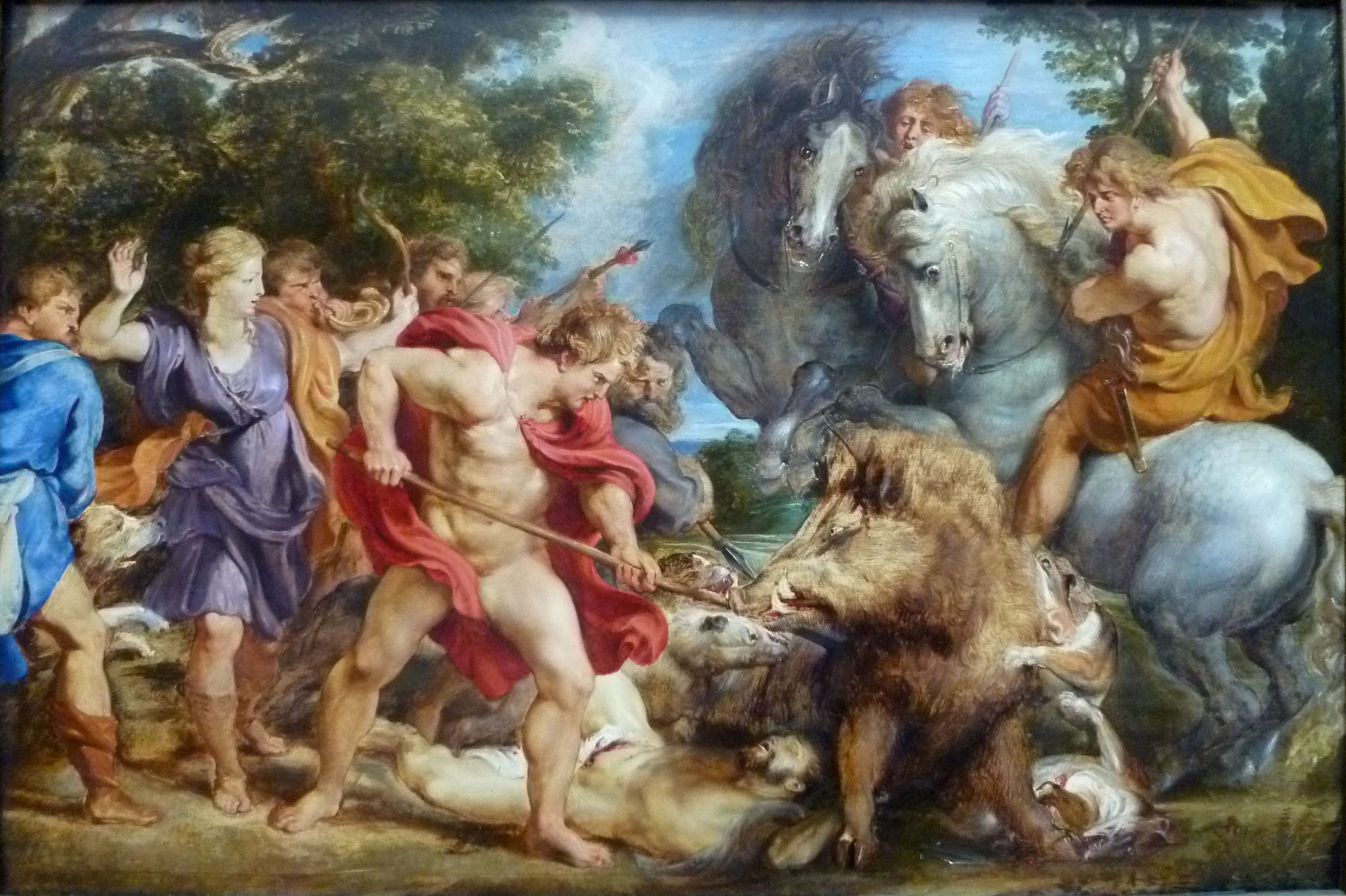
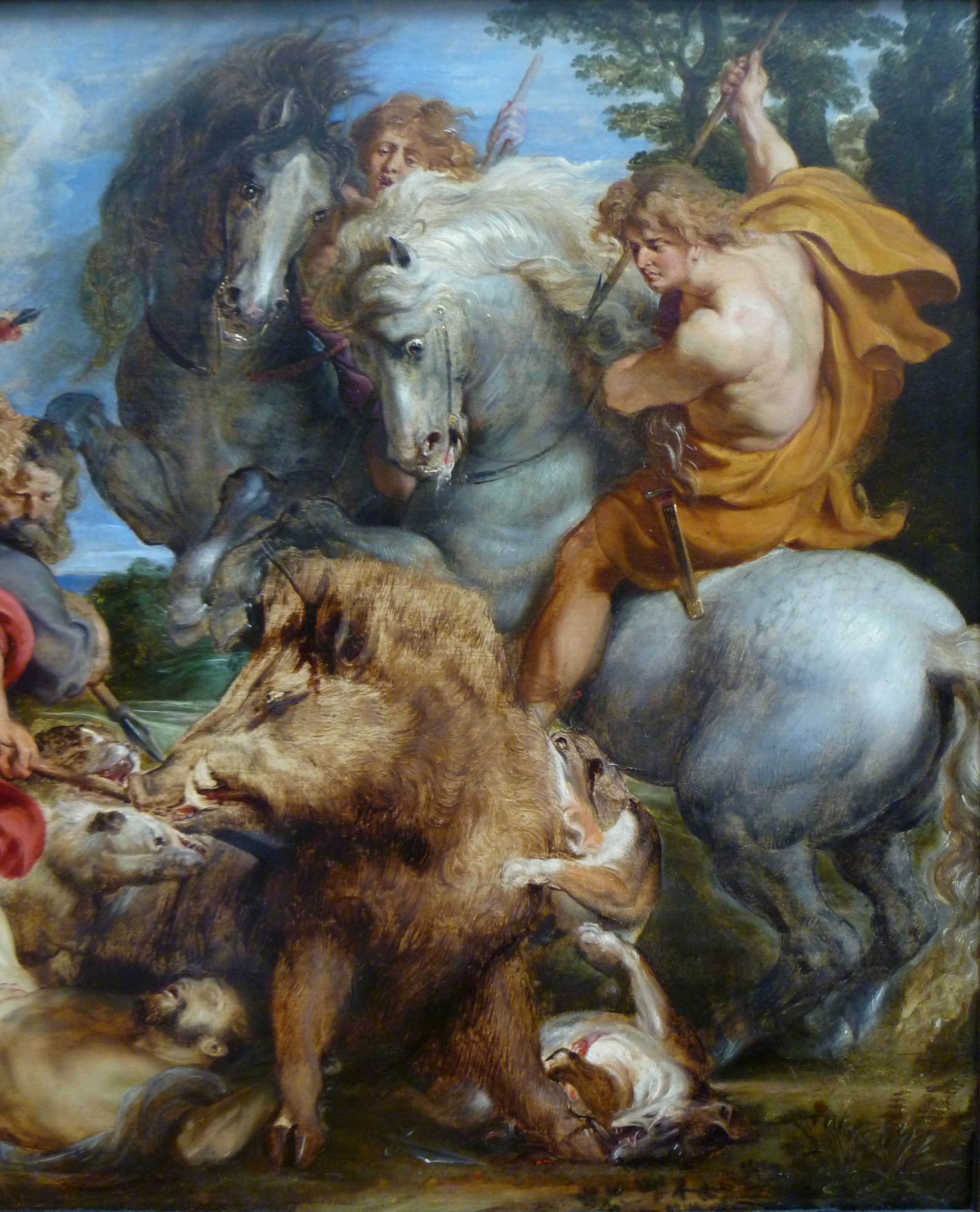
The Calydonian Boar Hunt, about 1611-12, Peter Paul Rubens, oil on panel

“This recently discovered painting is Ruben’s earliest hunt scene. In the early 1610s Rubens devised new and highly influential imagery of great physicality and emotional intensity–heroic combats between man and beast that transformed Baroque art.”

“The hunt of the Calydonian boar, a terrifying beast sent by the goddess Diana to punish King Oeneus, was a rare subject in painting. Rubens depicts the climax of the myth, when Meleager delivers the mortal thrust of the spear into the boar’s shoulder. The robust figures recall the classical sculpture from which he drew his inspiration. Rubens’ energetic and varied brushwork relates both to his brilliant oil sketches and to his polished cabinet paintings. He may have kept this work in his studio as a source of inspiration.”

RubensTheCalydonianBoarHunt1

A second take:

RubensTheCalydonianBoarHunt2

And some closeups:

RubensTheCalydonianBoarHuntCloseup

RubensTheCalydonianBoarHuntCloseup1

RubensTheCalydonianBoarHuntCloseup2

And lastly for today, a Rubens’ sketch:

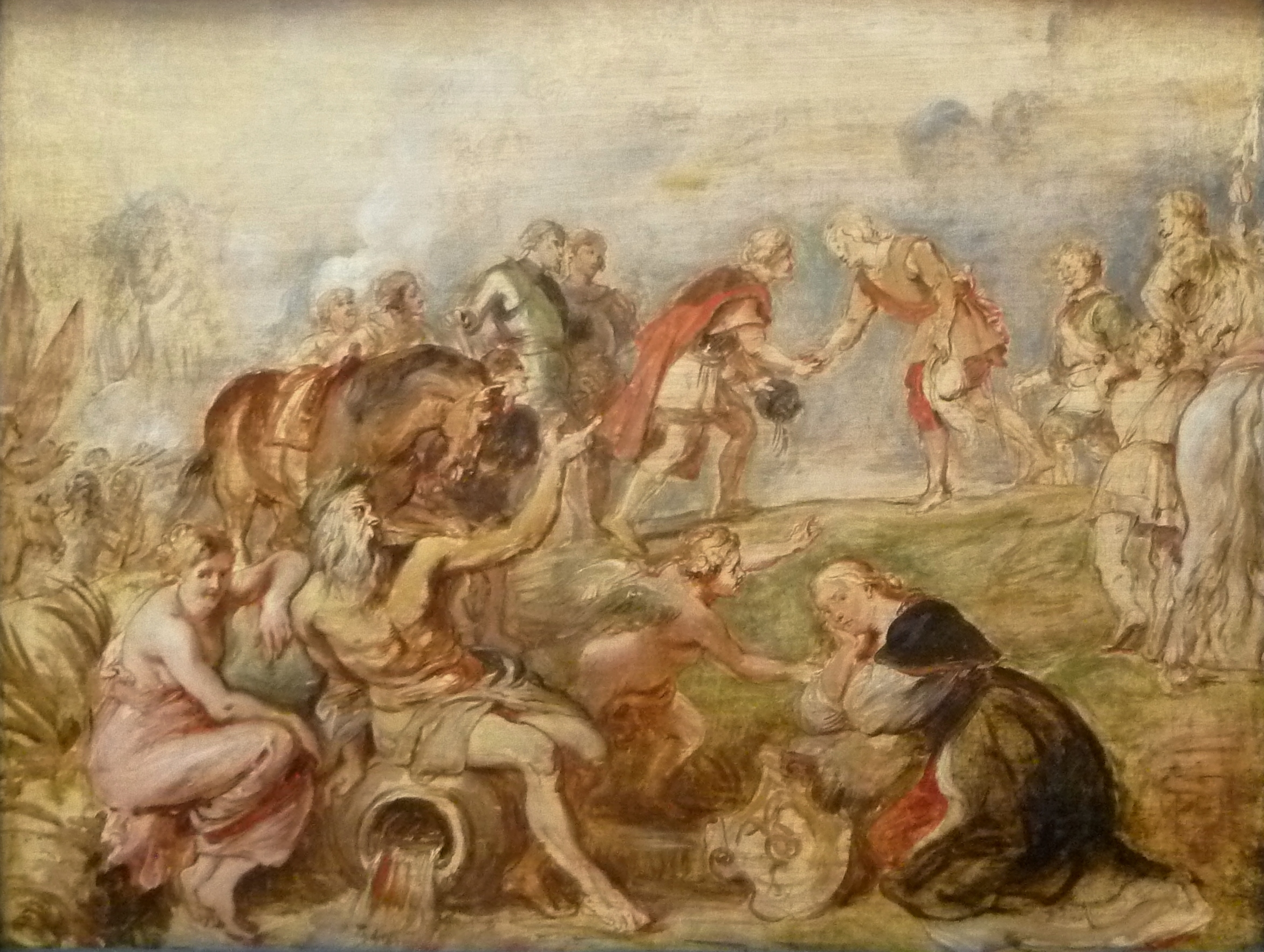
The Meeting of King Ferdinand of Hungary and the Cardinal-Infante Ferdinand of Spain at Nordlingen, 1635, Peter Paul Rubens

“This sketch was made for a monumental canvas that decorated a triumphal arch erected for the ceremonial entry into Antwerp by the Cardinal-Infante Ferdinand of Spain. It celebrates an alliance between Catholic rulers shortly before their combined armies scored a victory over Protestant forces in 1634. Rubens’ oil sketches are admired for the spirit and economy with which they present the main elements of his grand compositions.”

RubensSketchTheMeetingOfKingFerdinandOfHungary1

Note: All text in quotes is taken from the Getty or de Young museum placards posted beside paintings.

VERMEER AT THE GETTY

VermeerWomanInBlue

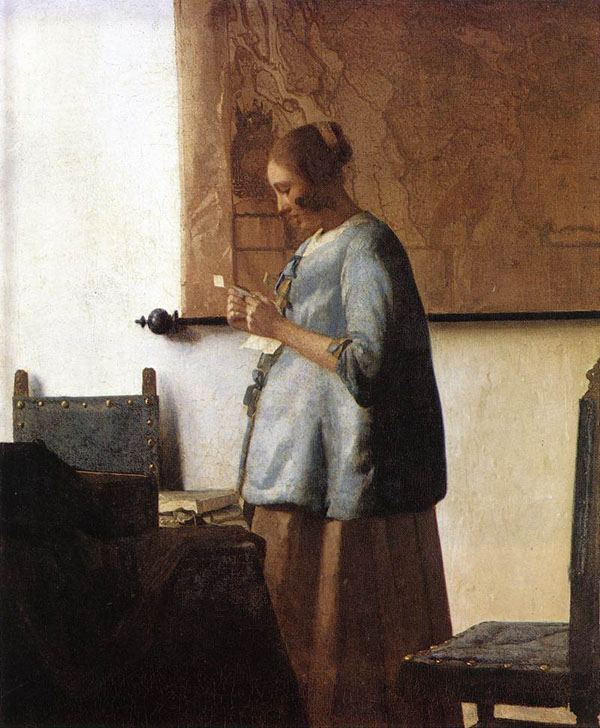
Woman in Blue Reading a Letter, about 1663–64, Johannes Vermeer (Dutch, 1632–1675)

Oil on canvas (18 5/16 x 15 3/8 in.), Rijksmuseum, Amsterdam. On loan from the City of Amsterdam (A. van der Hoop Bequest).

VermeerWomanInBlueBeforeRestoration

Woman in Blue Reading a Letter,  before restoration.

Information from the Getty Museum, Los Angeles:

http://news.getty.edu/press-materials/press-releases/vermeer-masterpiece-woman-in-blue-reading-a-letter.htm

One of Johannes Vermeer’s most celebrated masterpieces, Woman in Blue Reading a Letter, “comes to the Getty on special loan from the Rijksmuseum in Amsterdam, which is completing ten years of extensive renovations this year. Since October 2012, Vermeer’s masterpiece has traveled the world as an “ambassador” for the Rijksmuseum’s remarkable collection of Dutch paintings. Following presentations in Shanghai and São Paulo, Los Angeles is the last and only North American stop on the painting’s tour, after which it will return to Amsterdam in time for the Rijksmuseum’s much-anticipated opening on April 13, 2013.”

“’This truly represents an extraordinary opportunity for Southern California,” explains Timothy Potts, director of the J. Paul Getty Museum. “Vermeer’s Woman in Blue is one of his greatest and most famous masterpieces. It has very rarely traveled outside of Amsterdam and this is the painting’s first visit to the West Coast. Vermeer’s paintings of women reading letters and engaged in other private, domestic activities have a unique intimacy and reality to them that can only be fully appreciated in the flesh. His finest works, like the Woman in Blue, have a magical immediacy that has never been rivaled.’”

“Praised as one of Vermeer’s most beautiful paintings, Woman in Blue Reading a Letter demonstrates the artist’s exceptional command of color, light, and perspective. Portraying a young woman absorbed in a letter, it exemplifies the artist’s ability to create innovative scenes of everyday life imbued with great emotional intensity.  The mystery of the painting makes it even more compelling— although it is most likely a love letter, we do not know who the letter is from, what it is about, or why the painting’s subject is so engrossed by the correspondence.”

“’This small but powerful painting is exquisitely nuanced, with a marvelously balanced composition and refined use of light that creates a soft, diffuse atmosphere,” suggests Anne Woollett, curator of paintings at the Getty Museum. “Vermeer’s extraordinary command of color is apparent here and visitors will surely be taken with the varied hues of blue that he used throughout the painting.’”

“Woman in Blue Reading a Letter was recently cleaned and studied in Amsterdam by the Rijksmuseum’s restoration department. Past treatments were rectified and the yellowed varnish was removed, reestablishing the legibility of the composition. Significantly, the treatment revealed Vermeer’s brilliant range of blue hues, visible in their remarkable intensity for the first time in generations, along with a subtle palette of taupes, yellows, ochres, and whites, which themselves have a bluish tint.”

“Technical studies of the painting, also done at the Rijksmuseum, have revealed that Vermeer made important adjustments to the composition while working on the painting. For example, he extended the left vertical edge of the map on the wall behind the woman toward the window, narrowing the field of white created by the wall. He also eliminated the flared shape of the back of the woman’s blue jacket, emphasizing her vertical presence. Both changes serve to focus the viewer’s attention on the female subject and her thoughts.”

I feel so fortunate to have seen this painting. It is a work of fine, delicate beauty that one must really see to fully appreciate.

Note: All text in quotes is taken from the Getty or de Young museum placards posted beside paintings.

REMBRANDT AT THE MUSEUM–NOT AN ALL FOOLS’ DAY JOKE

Here are more museum postings, which I will continue to do in order to give you the flavor of all we saw. Please keep in mind that there were many unavoidable light reflections, not only from the skylights and track lighting, but also from the surprising fact that many of the works were covered with glass; and no matter how good the museum quality of that glass, there were still added light aberrations in a few of the photos.

Today is Rembrandt’s day:

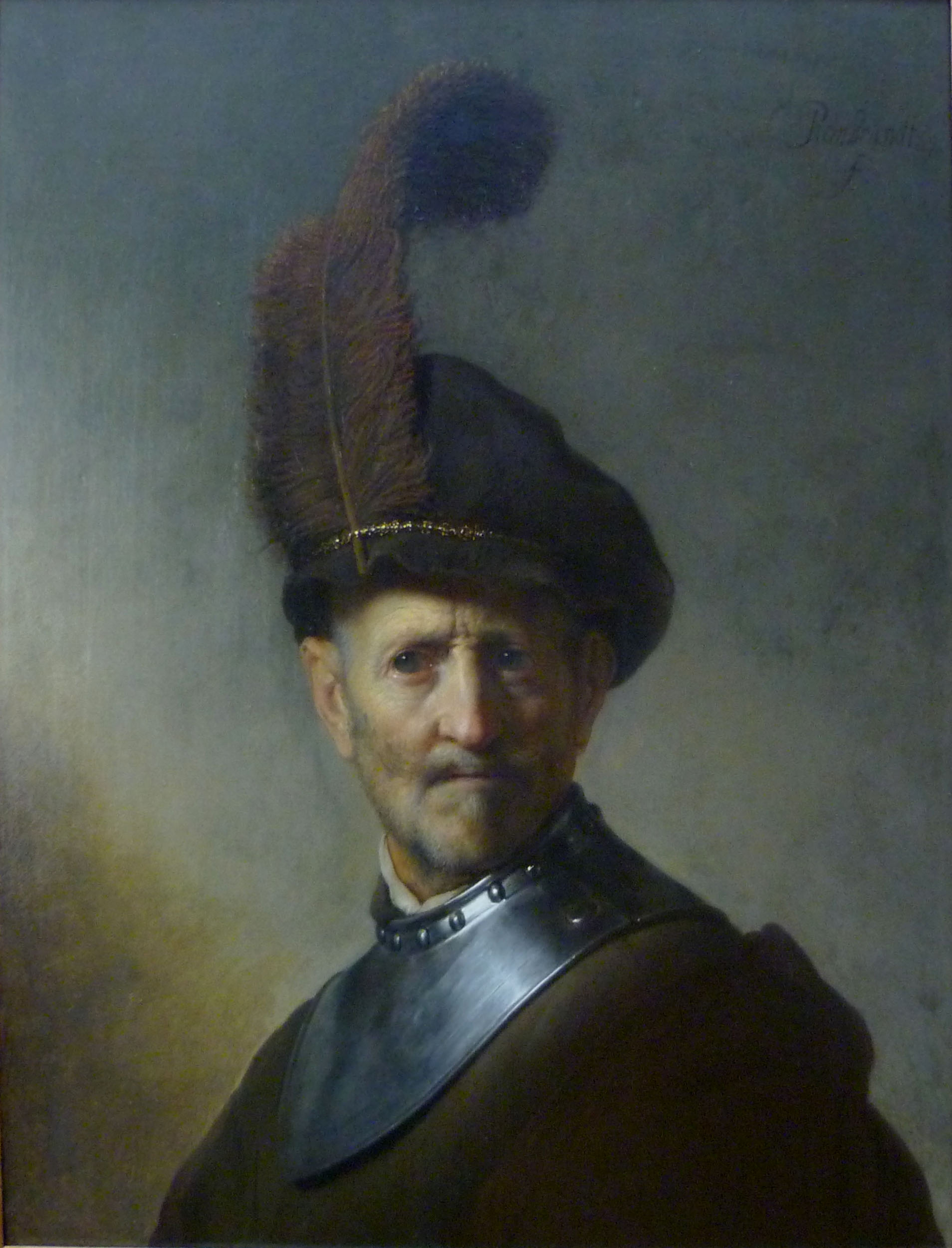
An Old Man in Military Costume, About 1630-31, Rembrandt Harmensz, van Rijn, Dutch, 1606-1669, Oil on panel

“This fantasy portrait belongs to the type known as a tronie, or a character study of a head. These pictures were created for sale on the open art market in Holland. Rembrandt frequently dressed the models for such portraits in fanciful costumes, as in the case of this man in military garb. The attire probably symbolizes Dutch fortitude and patriotism during the struggle for independence from Spain.”

RembrandtAnOldManInMilitaryCostume

The Abduction of Europa, 1632, Rembrandt Harmensz, van Rijn, Dutch, 1606-1669, Oil on panel (2 photos)

From the Getty:  “In the Metamorphoses , the ancient Roman poet Ovid told a story about the god Jupiter, who disguised himself as a white bull in order to seduce the princess Europa away from her companions and carry her across the sea to the distant land that would bear her name.

During his long career Rembrandt rarely painted mythological subjects. Here he conveys a narrative story through dramatic gesture and visual effects. Bewildered, Europa grasps the bull’s horn, digs her fingers into his neck, and turns back to look at her companions on the water’s edge. One young woman falls to the ground and raises her arms in alarm, dropping the flower garland intended for the bull’s neck into her lap, while her friend clasps her hands in consternation and watches helplessly. The carriage driver above rises to his feet and stares at the departing princess in horror. In the background, a city shrouded in mist extends along the horizon, perhaps serving as an allusion to the ancient city of Tyre as well as to contemporary Amsterdam.The dark thicket of trees to the right contrasts with the pink and blue regions of the sea and sky. Sunlight breaks through the clouds and reflects off the water, but the sky behind the trees is dark and foreboding.

A master of visual effects, Rembrandt took pleasure in describing the varied textures of sumptuous costumes and glittering gold highlights on the carriage and dresses.”

RembrandtTheAbductionOfEuropa

RembrandtTheAbductionOfEuropa

A Portrait of a Rabbi, About 1640-45, Rembrandt Harmensz, van Rijn, Dutch, 1606-1669, Oil on panel

“Rembrandt painted and drew numerous elderly male subjects in contemplation throughout his career. Here, strong light illuminates the man’s chest and face, which is energetically modeled with fine, textured brushstrokes. In contrast, the heavy folds of his gown and soft material of his hat are more loosely executed. Rembrandt was sensitive to Jewish tradition, and sought to capture its character through the representation of physical appearance and an internal spiritual state.”

RembrandtAPortraitOfARabbi

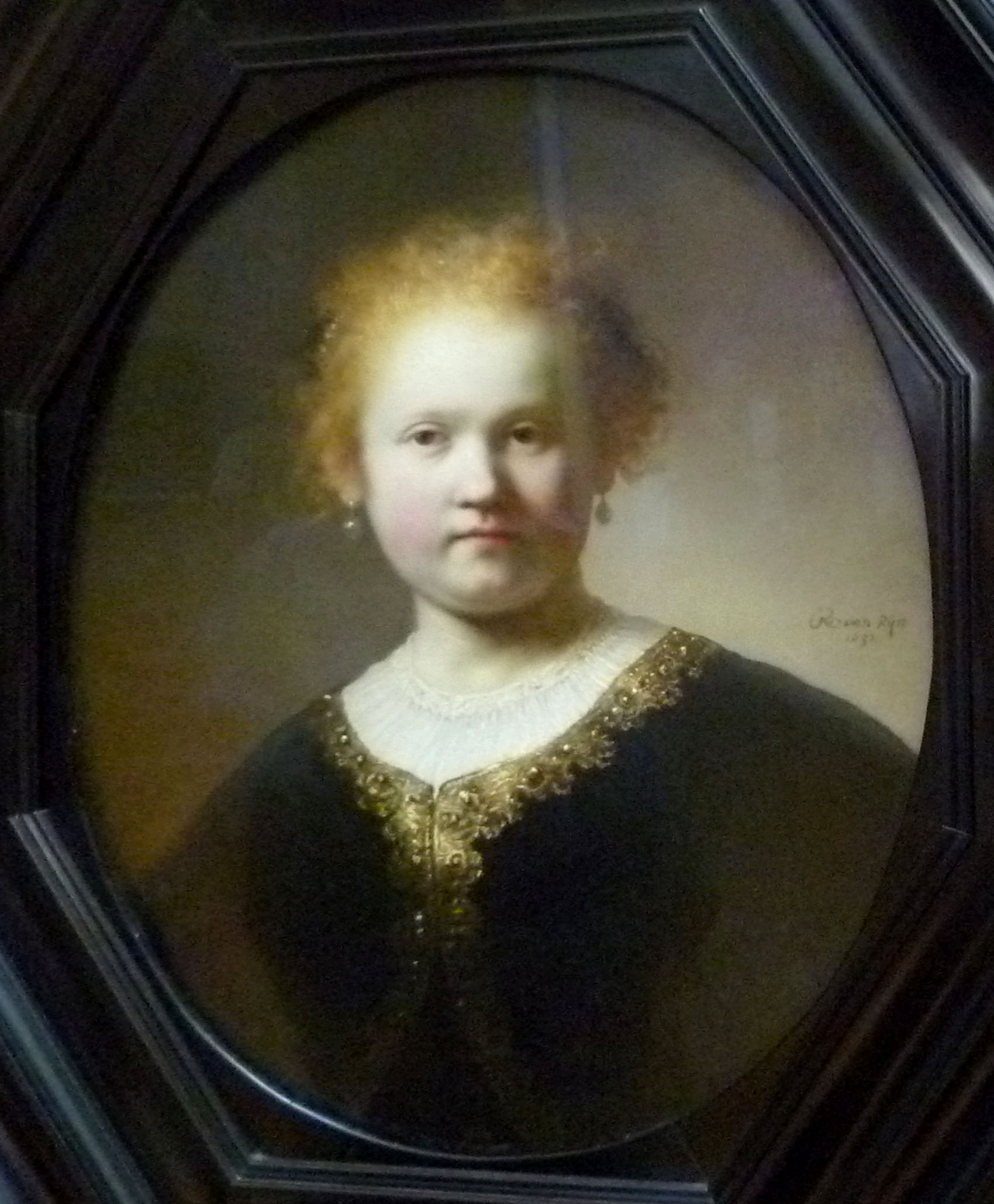
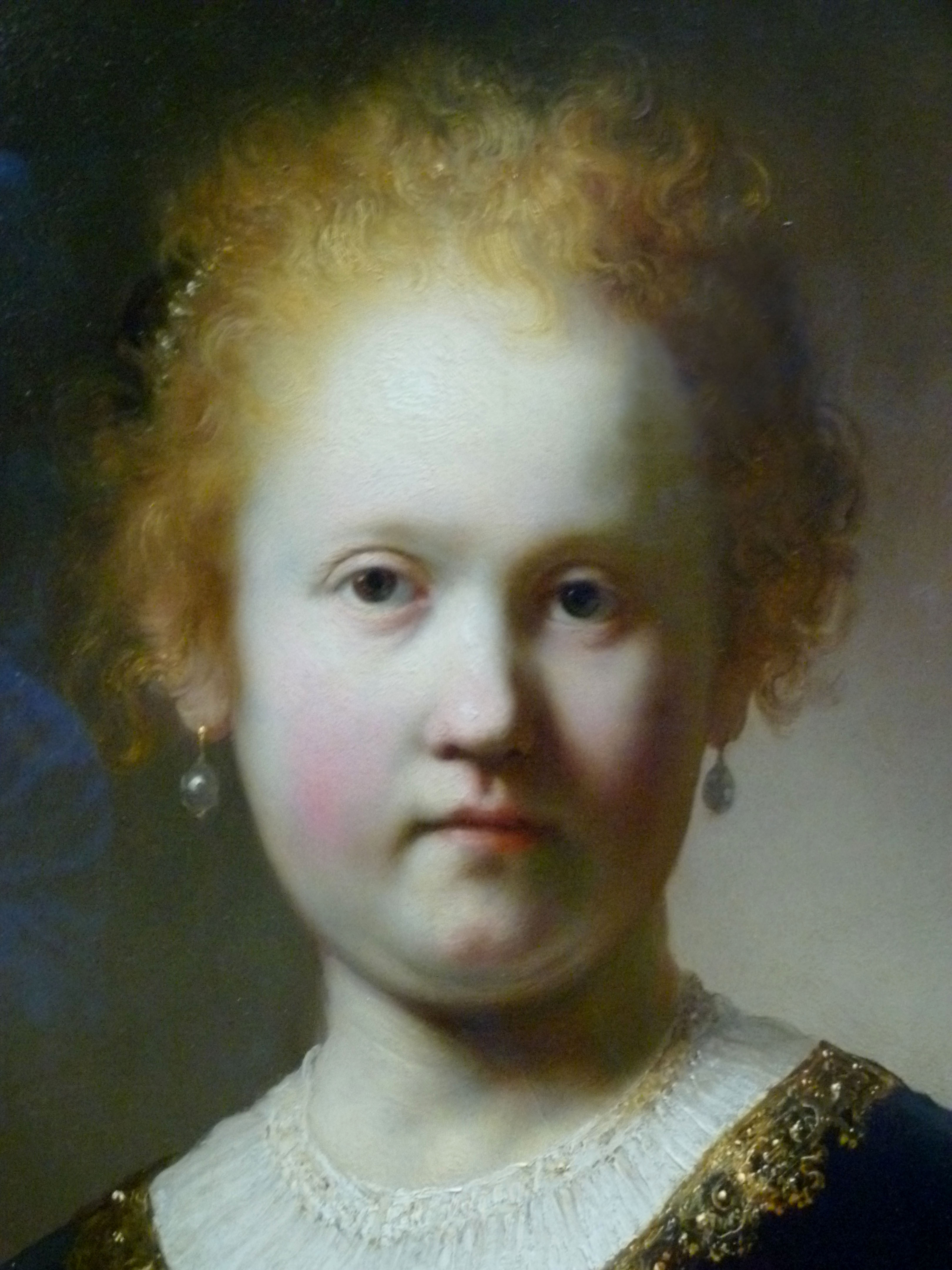
Portrait of a Girl Wearing a Gold Trimmed Cloak, 1632, Rembrandt Harmensz, van Rijn, Dutch, 1606-1669, Oil on panel

RembrandtPortraitOfAGirlWearingAGoldTrimmedCloakCropped

RembrandtCloseupPortraitOfAGirlWearingAGoldTrimmedCloak

And from the Getty http://www.getty.edu/art/installation_highlights/rembrandt.html:

Rembrandt Harmensz. van Rijn‘s Portrait of a Girl Wearing a Gold-Trimmed Cloak is on temporary view at the J. Paul Getty Museum at the Getty Center. The work, which has not been on public view since the 1970s, is on loan from a private collection in New York.

The sitter, an unknown woman, is richly dressed in the fanciful costume Rembrandt favored for biblical and mythological paintings. He scratched in the thick, wet paint to create the pleats of the subject’s white shirt, and rendered gold embroidery on her black gown with almost an abstract series of daubs. Light from the painting’s upper left creates atmosphere behind the sitter and strongly illuminates one side of her rounded face, along with the strand of pearls in her hair and one of her large pearl earrings.

Portrait of a Girl Wearing a Gold-Trimmed Cloak inspired the facial types of many of Rembrandt’s heroines in the early 1630s.

RembrandtPortraitOfAGirlWearingAGoldTrimmedCloakGettyImage

We’re off on a three-day job, so more photos in a few days….

Note: All text in quotes is taken from the Getty or de Young museum placards posted beside paintings.

PHOTOGRAPHS OF PAINTINGS AND CAMERA LENS DISTORTION

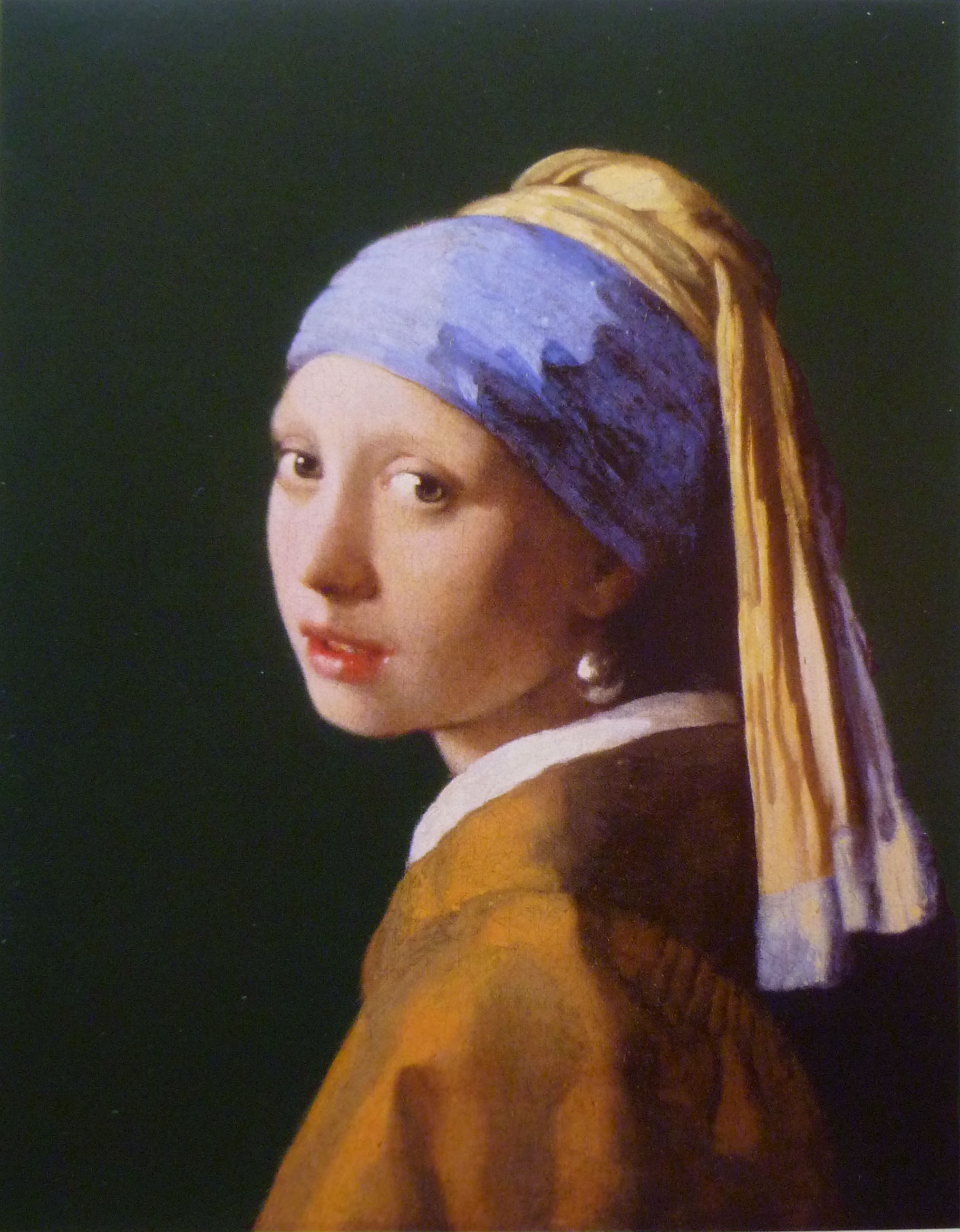
On our trip to the de Young and Getty museums last week, we took photos of paintings wherever possible. Of course I know it’s difficult for photography to capture the true essence of paintings and their myriad nuances of colors and values, but now I really know it. There aren’t many paintings like Girl with a Pearl Earring with which I have such intimacy, so arriving at a more complete understanding of this was a kind of epiphany for me.

During the painting’s latest restoration (1994), they discovered that Vermeer’s original background had a dark green enamel-like surface, accomplished through the application of glazes. However, the pigments available to him faded so much over 350 years, that the background looked blackish. This was corrected by the restorers and now, you can almost see the brushstrokes of the slightly sketchy transparent earthy-green glaze applied over the dark background underpainting.

Here is a photo of a high-quality postcard I bought, since the de Young did not allow photos of the special exhibit on loan from the Mauritshuis, particularly of the “Dutch Mona Lisa,” as she is called. They had her under guard at all times. Although a photo doesn’t pick up on the background color that well, can you see the slightest hint of  green?

VermeerGirlWithAPearlEarring

And here is a photo of the installation of Vermeer’s Woman in Blue Reading a Letter. Look at how the line curves where the floor and wall meet–this is an excellent example of barrel lens distortion:

vermeerinstall

And on the subject of picture taking, what photography can and cannot do has been discussed and written about ad infinitum, so I won’t go into it much here other than to say that if you are painting from photographs, a solid understanding of the way the camera plays tricks on you is essential. Certainly it matters the quality of camera and lens you use. However, beyond that, you must be aware of how all cameras visually distort images, and then make adjustments in the painting you create from these photos.

For example, make sure to adjust your composition to account for the camera’s barrel distortion (convex lines), pincushion distortion (concave lines),  flattening; and adjust for the fact that reds will “read” much darker in value than they really were when you took the photo. You can make these changes right on you drawing, or they can be adjusted in Photoshop first. We all love what cameras do for us, but be aware that edges will appear sharper and you will have to soften them in your painting to create recession in your work. As Frank Covino always teaches, “Don’t gray the shadows; gray the shadow’s edges.” You must soften edges where you want to round your images and make them appear recessional.

You can always tell when someone paints from photos and is unaware of flattening, for instance. The subject’s hands or feet will appear larger than they are in real life, and out of proportion with the rest of the figure, because hands or feet are typically in front of the figure. You must know this and make them proportionately smaller in your drawing to compensate and adjust sizes to their correct proportions. In other words, don’t make the hands as big as the head, even though they may appear that way in the photo.

You can find out more about the subject of camera distortion at this excellent site: http://www.kenrockwell.com/index.htm

Also, James Gurney at http://www.gurneyjourney.blogspot.com (the famous creator of Dinotopia) has provided an ongoing and wonderfully thorough exploration into how we humans see.

Something that struck me about these exhibits were that, no matter how much impasto the artist used, they began with the smoothest of canvases or boards. I looked up at various angles and marveled at how perfectly prepared they were. I can never seem to get mine that smooth but I continue to search for the trick to it.

Another thing that surprised me was Girl with a Pearl Earring‘s eye color; they are not light golden brown, or blue, or green, or gray. They are gray-blue with the absolute slightest hint of light golden brown, so difficult to describe. I stood there trying to figure out how he accomplished that and if I were trying to duplicate that color without causing the eyes to become greenish, I would paint them gray-blue first, let them dry completely, and then ever so gently, glaze just a small part of the reflected light area of the iris with a golden brown glaze. I still can’t imagine how Vermeer really did it, but that would be how I would approach it.

Below are some other photos (including 2 closeups) I took that you might enjoy:

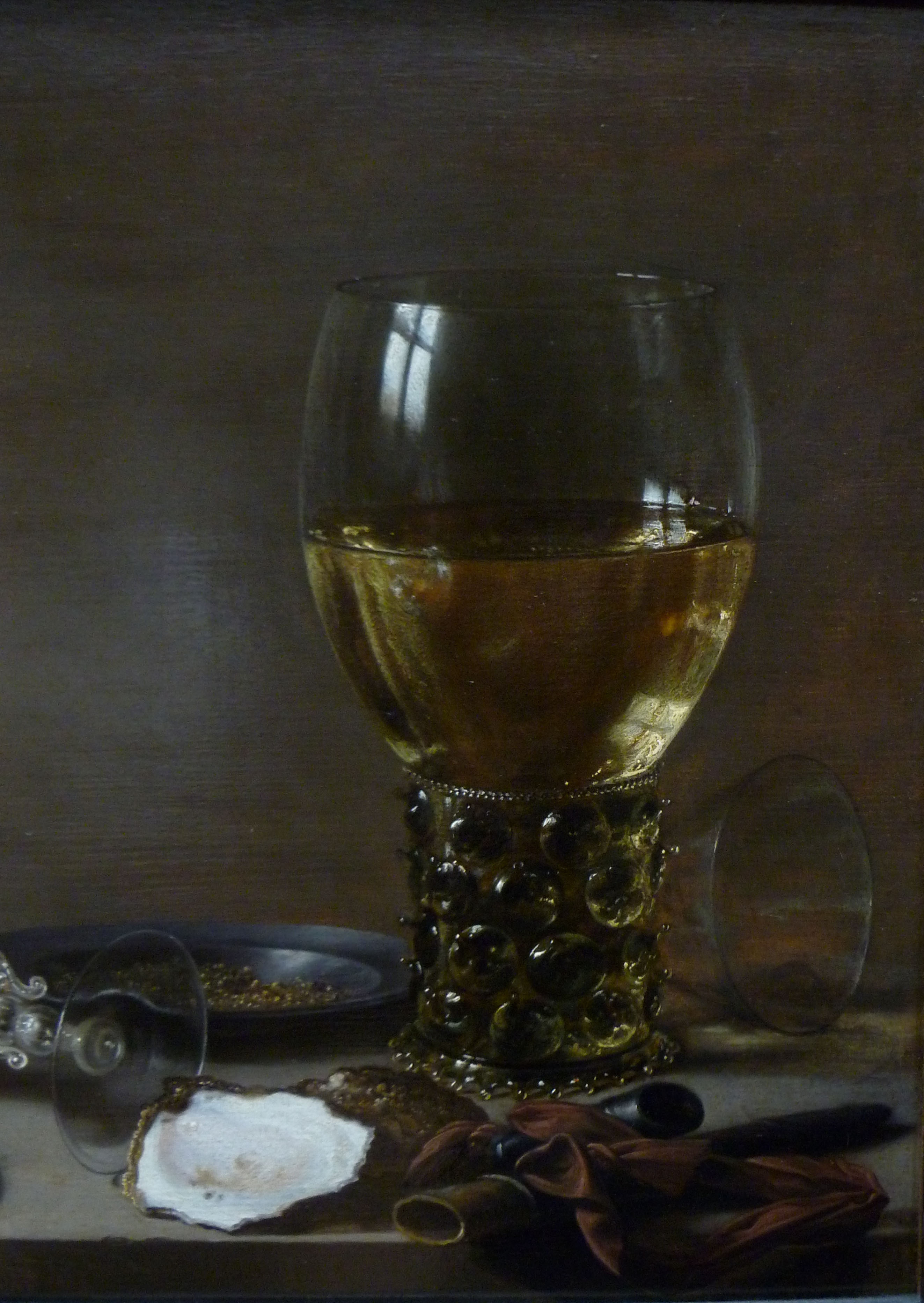
A Banquet Piece, About 1630, Pieter Claesz, Dutch, 1596/97-1660, Oil on panel

“A shaft of light from an unseen window poetically illuminates the textures and surfaces of a few objects on a stone ledge. This type of still life, known as a “monochrome banquet piece” for its harmonious though limited palette of browns and grays, was an artful invention intended to astonish the viewer with its beauty rather than a portrayal of an actual meal. Imported items such as a peeled lemon and the overturned Venetian-style glass contrast with local oysters and the monumental Dutch drinking glass with a textured stem. Claesz’s nuanced rendering reveals his interest in optical effects, such as the reflected windowpanes and the fall of light across the luminous lemon rind.”  de Young Museum

PieterClaeszTheBanquetPiece

PieterClaeszABanquetPieceCloseup1

PieterClaeszABanquetPieceCloseup

Mars and Venus Surprised by Vulcan, About 1606-10, Joachim Wtewael, Dutch, 1566-1638, Oil on copper

“Here the blacksmith god Vulcan pulls back the fine metal net in which he has trapped his wife, Venus, and her lover, Mars, exposing them to the laughter of their fellow gods. Like other Mannerist painters, Wtewael delighted in complexity and paradox. In this work he presents heroic figures on a tiny scale and Olympian gods in a compromising situation.”

JoachimWte

I had to take this photo through a glass case. I have been experimenting with painting on copper as many of the Old Masters did so, and saw the paintings on copper exhibit at the Phoenix Art Museum many years ago. They are exquisite to this day, with no craquelure. Experts attribute this to the fact that copper expands and contracts at approximately the same rate and temperature as does traditional oil paint.

Note: All text in quotes is taken from the Getty or de Young museum placards posted beside paintings.

GETTY AND DE YOUNG TREASURE TROVE

We have returned from our 1,870-mile anniversary vacation and we practically killed ourselves trying to see everything! But alas, we proved it impossible. We allowed a whole day for each museum but it wasn’t close to being enough. Plan for three solid days at the de Young Museum in San Francisco, and at least two complete days at the Getty Center in Los Angeles–and that is just to see each piece of art for a mere minute.  To really see the paintings, a much longer analyzing/examining/admiring time is required. And of course, this doesn’t include all the other attractions both museums have to offer.

In addition to rooms full of famous art, we saw Vermeer‘s Girl with a Pearl Earring at the de Young,

GirlWithAPearlEarringDeYoungAd

and his Woman in Blue Reading a Letter at the Getty.

WomanInBlueReadingAletter

Sadly, the de Young did not allow photos of Vermeer’s Girl, or of any other Dutch paintings on loan. The Getty was much less restrictive and allowed photos of Vermeer’s Woman, and virtually all paintings on exhibit. However, the skylights at the Getty were disconcerting at times. It caused some of the paintings to have excessive reflections and made them difficult to see.  It wasn’t a huge problem, but worth mentioning; standing farther back from the works helped with this, as did the time of day affecting the angle of the light.

Both museums are much easier to navigate than their online directions suggest. The de Young is slightly more difficult to drive to, and we found the layout a bit more confusing and involved–like a maze you can’t find you way out of–but that was probably because it’s a bit larger than the Getty, and because the Getty is organized by separate buildings in very close proximity to each other, but that serve to break up the collections in a more logical way.

The Getty was very easy to get to and, once there, a tram takes you to the top of the hill and drops you off. The idea of having to use a tram sounded cumbersome at first, but it was so much easier than traffic and cars would ever be, and the parking garage was right at the base of the tram–a very easy and short walk. The Getty is FREE except for a $15 covered parking fee that also covers the tram ride. You honestly can’t lose your way here, even if you try, and the views are wonderful.

I took lots of pictures and will post many of them over the next few days, so settle in for a mini online tour of paintings.

Note: All text in quotes is taken from the Getty or de Young museum placards posted beside paintings.

WE’RE OFF TO SEE THE WIZARD (OF PAINTING, THAT IS)

Vermeer's original painting, Girl with a Pearl...

Vermeer’s original painting, Girl with a Pearl Earring from 1665 (Photo credit: Wikipedia)

Remember in my first posts I said we were going to see Vermeer‘s Girl with a Pearl Earring at the deYoung Museum in San Francisco, and Woman in Blue Reading a Letter at the Getty Center in Los Angeles? Well, the day has finally arrived!  We’re loading the car right now and we will be on our way ASAP.  We plan to go up Highway 1 for its luscious scenery and photo ops (a.k.a. painting fodder), even though it will take a lot longer. If I can post anything on the way, I will, but no promises since we’re “winging it” for fun. But I’ll show and tell all when I return.

The museums allow no-flash photography only, on pieces they themselves own, but not for anything on loan–bummer, so I’ll have to settle for gift shop prints.

I’m taking a giclée of my GWAPE (see earlier post) so that I can compare it directly with the real version.

We got so lucky with the timing of our visit to the deYoung because it just happens to fall in that one week each year when San Francisco’s floral designers display their creations at the museum for a show called, Bouquets for Art. From the pictures I’ve seen, I imagine it will be exquisite.

Soon, I will be posting lots of photographs for you to see.  Until then, I hope you have a wonderful week.

Johannes Vermeer - Woman in Blue Reading a Let...

Johannes Vermeer – Woman in Blue Reading a Letter – WGA24657 (Photo credit: Wikipedia)

MORE ON THE IMPORTANCE OF VALUES

Excerpt from French Art: Classic and Contemporary Painting and Sculpture by W. C. Brownell, 1901. Download and read the book for free from the University of California Archive, http://archive.org/details/frenchartclassic00browrich

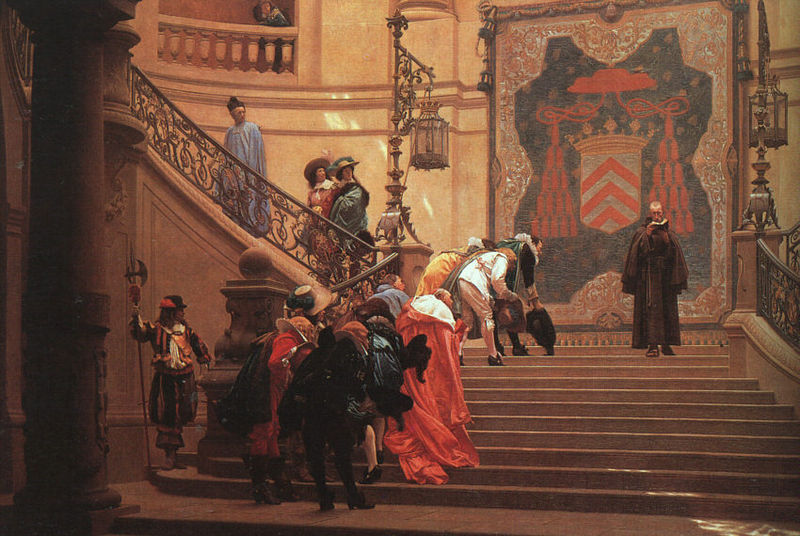
Manet‘s great distinction is to have discovered that the sense of reality is achieved with a thousand-fold greater intensity by getting as near as possible to the actual, rather than resting content with the relative, value of every detail. Every one who has painted since Manet has either followed him in this effort or else has appeared jejune (a.k.a. simplistic, superficial, dry, uninteresting).

Take as an illustration of the contrary practice such a masterpiece as Gerome’s “Eminence Grise.” In this picture, skilfully and satisfactorily composed, the relative values of all the colors are admirably, even beautifully, observed. The correspondence of the gamut of values to that of the light and dark scale of such an actual scene is perfect. Before Manet, one could have said that this is all that is required and the best that can be secured, arguing that exact imitation of local tints and general tone is impossible, owing to the difference between nature’s highest light and lowest dark, and the potentialities of the palette. In other words, one might have said that inasmuch as you can squeeze absolute white and absolute black out of no tubes, the thing to do is first to determine the scale of your picture and then make every note in it bear the same relation to every other that the corresponding note in nature bears to its fellows in its own corresponding but different scale.”

GeromeEmeninenceGrise1873

PIGMENTS AND ASTM STANDARDS

ASTM Certification of 1947

ASTM Certification of 1947 (Photo credit: Wikipedia)

I am  rather obsessed by the quality of the materials I put into my paintings from the surface, up, for a number of reasons–not the least of which is I want them to be around l-o-o-o-ong after I’m gone. Also, when someone hires me to do a job, I want to make sure it is the best I can give–I feel I owe that to people placing their trust in me.

ASTM stands for the American Society for Testing and Materials and it is the organization that helps to internationally standardize a very large number of materials including paint. The “P” stands for “pigment” and the letter(s) stand for R-red, Y-yellow, B-blue, Br-brown, and so on. The numbers after the letters indicate the specific pigment. This is why you will find that the “PR83” (a very impermanent but much-loved pigment) on your paint tubes means “Pigment Red Alizarin Crimson” in the ASTM standard, no matter what brand of paint.

But you can’t go by the name companies put on the face of their tubes–that is just a label and an oftentimes misleading one.  For example, Utrecht has an oil paint labeled “Titanium White” but in checking the label closely, we find it is NOT just titanium white (PW6), but has zinc white (PW4) in it as well. PW4 has undergone extensive study at the Smithsonian Institute and they have determined it will make your paintings crack over time.  When I learned this, I checked all the tubes in my paintbox and got rid of the ones that had zinc white in them.

Here is what I’ve gathered in my research:

PIGMENT LIST

(* Do Not Use)

 REDS:

Cadmium Red PR 108 ASTM  l (ranges scarlet to maroon, slow drier, hard, flexible, use CP)

Pyrrole Red PR 254 ASTM  l (equal to Cads for permanence. Recommend replacing more poorly performing Napthols, Perylenes, and Anthraquinones with Pyrroles where similar shades exist. Pyrroles are pigments to trust. From auto industry research.)

Pyrrole Alizarin PR 264 ASTM l (BEST replacement for alizarin crimson; gorgeous undertone)

*Alizarin Crimson PR 83 ASTM l l l (brittle, cracks, darkens, too impermanent for enduring art)

*Rose Madder NR 9 ASTM  l l (textile dye, weak color)

Venetian Red PR 101 ASTM  l  aka English Red, Light Red, Red Oxide, Indian Red, Mars Red, Mars Violet, Caput Mortuum (Genuine Venetian Red from the quarry where Titian obtained his supplies is still available from Blockx.)

Quinacridone Magenta PR 122 ASTM l (bright blue-red, transparent, strong, very recommended)

Quinacridone Red, Quinacridone Violet PV 19 ASTM  l (true reds to lipstick pinks, deep rose to red-violets)

Quinacridone Red Y  PR 192  ASTM  l (bright, clean color, high lightfastness & tinting strength)

Quinacridone Scarlet  PR 207  ASTM  l (high performance pigment due to lightfastness)

Napthols fade in tints. Even those classed as ASTM 1 barely scrape in. Noticeably less light fast.  There are other reds that are far superior.

*Napthol Red F4HR  PR 7  aka Napthol AS-TR  ASTM  l  (beautiful bluish-red but fades)

*Napthol Red FG  PR 119  ASTM  l (clean, bright yellowish-red)

*Napthol Red HF3S  PR 188  ASTM  l (very pure yellowish-red)

*Napthol  ITR  PR 5  aka Napthol Carmine FB  ASTM  l l (deep crimson red)

*Napthatol AS-OL PR 9 aka Permanent Red FRLL  ASTM  l l (Poor light fastness esp. in tints)

*Napthol AS-OL  PR 14  aka Napthol Bordeaux FGR  ASTM  l l (very dark red)

*Napthol Red AS-D  PR 112  aka Permanent Red FGR, Permanent Carmine ASTM l l

*Napthol Red F5RK  PR 170  aka Napthol Carbamide  ASTM  l l (bright strong bluish-red)

*Napthol Red AS-D PR 17  aka Napthol Red  ASTM  l l l (too impermanent for serious artwork)

*Napthol Red PR 146 aka Napthol Carmine FBB ASTM  l l l  (notice how fading pigments get labeled “permanent”)

Light Red PR 102  ASTM  l (a beautiful, transparent red earth; Cenini gathered it w/his father)

Transparent Red Oxide PR 101 ASTM  l (Beautiful! transparent, redder than burnt sienna)

*Vermillion PR 106  (Poisonous!)

Perinone Red Deep PR 194 ASTM 1 (high performance deep red, recommended)

*Perylene Vermilion PR 123 ASTM l (bright transparent red; ALL perylenes fade in tints)

*Perylene Red BL PR 149 ASTM l (excellent brightness)

*Perylene Red PR 178 ASTM l (excellent lightfastness)

*Perylene Maroon PR 179 ASTM l (excellent lightfastness but lacks brightness)

*Perylene Scarlet PR 190 ASTM l (very good light fastness)

*Anthraquinoid Red PR 177 ASTM l (very transparent, fades in tints)

*Brominated Anthranthrone PR 168 ASTM l l (dull, low-strength tints)

Benzimidazolone Red HFT, aka Benzimidazolone Maroon PR 175 ASTM l (lacks brightness)

*Ultramarine Red PV 15 ASTM l (too pale and weak to be useful)

Permanent Red, aka Thioindigoid Red. PR 88 ASTM l (excellent lightfastness, recommended)

ORANGES:

Cadmium Orange PO 20  ASTM l (get CP grade, otherwise has 15% Barium Sulfate)

Perinone Orange PO 43  ASTM l (perfect alt. to Cadmium Orange if more transparency needed)

Quinacridone Burnt Orange PO 206 ASTM l (beautiful dark reddish, similar to burnt sienna)

Quinacridone Gold PO 48 ASTM l (lacks brightness in tints but excellent light fastness)

YELLOWS:

Mars Yellow aka Yellow Oxide PY 42 ASTM  l (a more pure yellow than the natural ochre)
Yellow Ochre aka Brown Ochre PY 43  ASTM  l (used since the dawn of time, esp. fleshtones)

Cadmium Yellow PY 37  ASTM  l (Although industry accepts up to 15% Barium and/or Lithopone as normal, the Chemically pure Cadmium Sulfide has a cleaner color and is noticeably stronger in tinting strength. The description 99.9% Cadmium Sulfide or the initials CP seen on the label of a few of the best grades of artist’s paint refers to the Chemically Pure Cadmiums.)

*Cadmium Yellow Light PY 35  ASTM  l (Zinc in cadmium zinc sulfide may not be not as stable as the Cadmium component and so the palest lemons are not regarded as light fast as the less light versions. The color is close to being the perfect mixing yellow as it is very close to “primary yellow.” If you use, Chemically Pure—CP— pigment is recommended.)

*Aureolin PY 40 ASTM  l l
Nickel Titanate aka Nickel Yellow or Nickel Titanium Yellow PY 53 ASTM  l (recommended)
*Arylide Yellow PY 65 ASTM  l

*Arylide Yellow GX PY 73  ASTM  l

*Arylide Yellow 5GX PY 74  ASTM  l

*Diarylide Yellow HR70 PY 83  ASTM  l

*Arylide Yellow FGL PY 97 ASTM  l

Nickel Azo Yellow PY 150 ASTM  l (very greenish yellow, excellent light fastness)

Benzimidazolone Yellow H4G PY 151 ASTM l (green-yellow, excellent lightfastness, dull tints)

Nickel Dioxine Yellow PY 153 ASTM  l (a bright yellow, makes dull tints)

Benzimidazolone Yellow H3G PY 154 ASTM  l (excellent light fastness, makes dull tints)

Benzimidazolone Yellow HLR PY 156 ASTM  l (transparent, excellent light fastness, dull tints)

Benzimidazolone Yellow H6G PY 175 ASTM  l (excellent light fastness, dull tints)

*Hansa Yellow Medium aka Arylide Yellow G, Azo Yellow PY 1 ASTM  l l  (Fades in tints.

PY 73 is virtually same color but has better light resistance. Being used less and less. Can bleed.)

*Hansa Yellow Light PY 3 ASTM  l l (transparent, greenish, fades in tints)

*Arylide Yellow 10GX. PY 98 ASTM  l l (bright, greenish, stronger than PY 3)

Anthrapyrimidine Yellow PY 108 ASTM l (transparent,bright,excellent lightfastness, avr.drying)

Flavanthrone Yellow PY 112 ASTM  l  (transparent, reddish, excellent light fastness, avr.drying)

*Zinc Yellow aka Zinc Chromate PY 36 ASTM  l l (Smithsonian says don’t use—it cracks!)

*Strontium Yellow aka Barium Chromate, Lemon Yellow PY 32 ASTM  l l

*Chrome Yellow PY 34 ASTM  l l (quickly discolors, darkens, poisonous, impermanent, avoid)

Naples Yellow aka Antimony Yellow PY 41 ASTM  l (Can get from Kremers. Greenish to pinkish pale. Tubes are often mixed white,ochre,red.Genuine pigment excellent, permanent;lead)

Isoindolone Yellow R PY 110 ASTM 1 (exceptional bright reddish, excellent tinting strength)

*Kings Yellow aka Orpiment PY 39 ASTM  l l  (Arsenic! Impermanent and poisonous)

*Massicot PY 46 ASTM  l l (poisonous, quite impermanent)

*Gamboge NY 24 ASTM  l l (golden glazing yellow, impermanent, replaced by Aureolin)

*Quercitron Lake NY 9 ASTM  l l

*Saffron NY 6 ASTM  l l (poor lightfastness, used in food prep.)

*Turmeric NY 3 ASTM  l l (poor lightfastness, used in food prep.)

Bismuth Yellow PY 184 aka Vanadium Yellow ASTM  l (like cad yellow but more transparent)

GREENS:

Chromium Green Oxide PG 17 ASTM  l (Dull, opaque, great permanence. Photographs under infra red as living foliage and so is used for military camouflage.)
Viridian aka Guignet’s Green PG 18 ASTM l (bright bluish, wise to pay premium for pure grade)

Cobalt Green PG 19, Light Green Oxide PG 50 (better) ASTM 1 (bright; low tinting strength)

Pthalo Green aka Monastral Green PG 7 (bluer), PG 36 (yellower) ASTM l (displacing Viridian)

Green Earth aka Terre Verte, Bohemian Earth, Burnt Green Earth PG 23 ASTM l (weak pigment; manufacturers usually use permanent, stronger mix of Sienna and Pthalo Green instead)

Hooker’s Green PG8 ASTM 111 (Avoid! Mix your own with Cad Yellow and Pthalo Blue)

Cadmium Green PG 14 ASTM l (Hard to find. Mix your own with Cad Yellow and Cobalt Blue)

BLUES:

Ultramarine PB 29 ASTM l (chemically identical to Lapis Lazuli) (30 different shades; brittle)

Cobalt Blue PB 28 ASTM l (Miners believed there were spirits in the mines called ‘Kobalds’ in the local tongue. Cobalt is named after these spirits that inhabited the mines. Fairly flexible.)

Pthalo Blue PB 15, 16 ASTM l (replaces Prussian Blue; especially good for mixing green-blues)
Cerulean Blue PB 35 ASTM l (one of the most opaque colors on the palette; fairly flexible)

Cobalt Chromate PB36 ASTM 1 (Beautiful turquoise–don’t confuse with Cerulean)

*Prussian Blue PB 27, also called Antwerp Blue, Paris Blue, Milori Blue, Iron Blue

*Azurite aka Bremen Blue PB 30 (doesn’t mix well in oils)

Indanthrone PB 22 ASTM 1 (clear deep blue, not as overpowering as Pthalo Blue)

Egyptian Blue aka Blue Frit PB 31 (largely disappeared in the 18th century)

Smalt (direct descendant of Egyptian Blue; weak but very permanent; popular until Ultramarine)

Zirconium Cerulean Blue PB 71 (A beautiful semi-opaque light blue, available from Kremer)

PURPLES:

Cobalt Violet PV 14 ASTM l (absolutely permanent, makes a hard, fairly flexible oil paint film)
Manganese Violet PV 16 ASTM l (reddish or blue shade, low tint strength, fast drying, flexible)

Quinacridone Violet PV 19 (red to red-violet) PR 122 (magenta) ASTM l (There are no inorganic pigments with this brilliance and purity;transparent, hard, fairly flexible, average drier)

*Dioxazine Violet PV 23  ASTM  l l (not nearly as permanent or lightfast as other violets)

Mars Violet aka Caput Mortuum PR 101 ASTM l (Confusingly indexed as a red. Superb! Use for tree trunks/old wood/summer landscapes. Used far less than it deserves. Means “head of the dead” and is the color of dried blood.)

Ultramarine Violet PV 15 ASTM 1 (great permanence; too weak to be of much use in oil paint)

Isoviolanthrone Violet PV 31 ASTM 1 (an excellent pigment of high light fastness)

BROWNS:

Raw Umber PBr 7 ASTM  l (Many color variants. Best pigment is from Cyprus, Turkey)

Burnt Umber aka Turkey Brown PBr 7 ASTM  l (many color variants, best from Cyprus)

Raw Sienna aka Italian Earth PBr 7 ASTM  l (browner than Yellow Ochre, wide color variety)

Burnt Sienna PBr 7 ASTM  l (“Half burnt” light browns to fiery oranges beloved by artists. Worth top dollar for best colors and hunting down color variants–some are extraordinary.)

Mars Brown  PBr 6 ASTM  l (Usually a blend of PY 42, PR101, PBk 11. Smoky brown, harder to find in natural earths. Lacks beautiful transparency loved in the Siennas and Umbers.)

*Van Dyke Brown also known as Cassel Earth or Cologne Earth (disastrous—always avoid)

*Asphaltum, aka Mummy, Asphaltum, Egyptian Brown (Avoid at all costs)

WHITES:

Titanium White aka Titanium Dioxide  PW 6  ASTM  l  (best all round white, very opaque)

*Zinc White PW 4 ASTM  l (28-year study: Smithsonian says take it off  palette—it cracks!)

Lead White, aka Flake, Cremnitz, Underpainting White, and Silver White PW 1 ASTM 1

BLACKS:

Mars Black aka Iron Black, Black Iron Oxide PBk 11 ASTM  l (fast drier)

Ivory Black aka Bone Black PBk 9 ASTM  l (slow drier—never use in underpainting)

*Lamp Black aka Carbon Black, Vegetable Black, Furnace Black PBk 6 ASTM  l

*Vine Black also called Drop Black, Frankfort Black, Peach Black, Spanish Black, Blue Black.

MISC:

*Metals PM 1, PM 2, PM 3, etc.  ASTM – Not tested. All except gold are poor.

Gold  PM 3 ASTM  l

*Mica PW 20 ASTM – Not Tested

Mica Titanate ASTM – Not Tested (New, micronized mica in wide range of metallic colors—appear to be highly light fast and useable in all media.)

MORE PIGMENT INFORMATION FROM:

RGH Paints, Pigment Identification Chart,  http://www.rghartistoilpaints.com/index.html

Explanation of Pigment Identification Chart:

(P Value) Permanence as rated by the ASTMD in Artists’ Oil and Artists’ Acrylic Emulsion Paints, as follows:

1. Excellent     2. Very Good     3. Good     4. Fair     5. Poor

(T Value) Transparency/Opacity as follows:

1, Least Transparent (Most Opaque), to 8, Most Transparent (Least Opaque)

Index Name

Pigments throughout the world are given a Color Index Name. This is an international code.

Remember that the science of paint continues to evolve, bringing us ever-more exciting options to use; so do some research on your own and learn more about it.  I’ll be posting more information on this next time.